Background
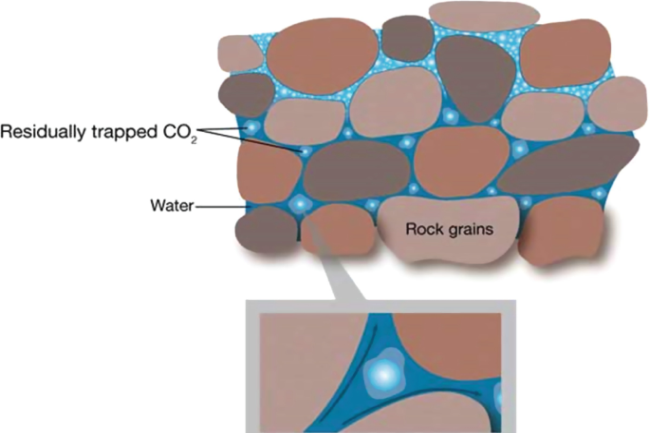
Carbon Capture and Storage is an inevitable technique of mitigating the hazardous effect resulting from carbon emission to the environment. Nonetheless, the effect of the sequestered CO2 on the rock with time needs to be fully understood. Experimental and geochemical modelling will be employed in this work. The rock-formation water will be aged first before injecting the CO2. This is to mimic the state of the rock-brine prior to the CO2 injection. The rock-fluids (i.e. brine and CO2) interactions are evaluated with time to assess the effect of the sequestered CO2. This will be carried-out using different minerals, mineral mixtures, rock samples and fluid samples. The rock-fluids system will also be modelled using a geochemical simulator (PHREEQ-C). The experimental results and the simulated counterpart will be compared before drawing conclusions.
Objectives
- A surface complexation model that seeks to predict the rock/brine/CO2 interactions during CO2 sequestration will be developed.
- To evaluate the role of different mineralogical composition of rocks and ionic composition of the formation water during CO2 sequestration
Proposed Method
- Experimental approach: CO2 will be injected into different rock-brine systems and monitored over time to ascertain the CO2 interaction during its sequestration.
- Simulation approach: Surface Complexation Modelling approach will also be employed to assess the complexes formed on the surface of the rock during the CO2 sequestration.